 By
Why Hard Water Is a Costly Problem for Businesses
Hard water does not always look unusual. It may be clear and apparently clean, yet contain dissolved calcium and magnesium that accumulate as scale on heated surfaces, inside pipes and across water-using equipment. Over time, those deposits can affect heat transfer, block narrow passages and increase cleaning requirements.
Factories, hotels, commercial kitchens, laundries and residential complexes often discover hardness problems only after heaters, valves or plumbing begin requiring frequent maintenance. For an industrial facility, the consequences can extend to process interruptions and inconsistent equipment performance.
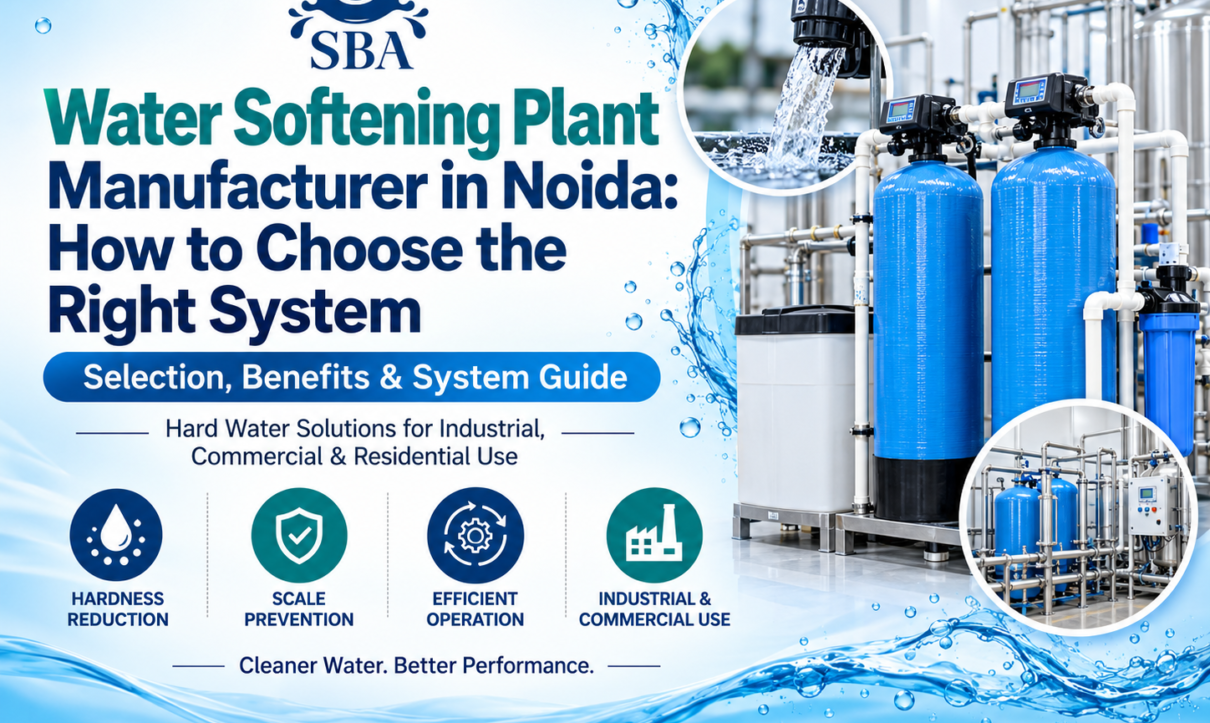
A dependable Water Softening Plant Manufacturer helps address the cause rather than repeatedly treating the symptoms. The right supplier evaluates the incoming water, calculates flow and hardness load, recommends an appropriate softening system and plans how it will be operated and maintained. This article explains the process, practical selection criteria and what to ask before commissioning a plant.
Quick Answer: What Does a Water Softening Plant Manufacturer Do?
A Water Softening Plant Manufacturer supplies equipment that reduces water hardness, typically by passing hard water through ion-exchange resin. The resin exchanges calcium and magnesium ions for sodium ions, and is periodically regenerated using a salt solution. Manufacturers may offer different capacities, vessel materials, control valves and regeneration arrangements. Choosing the right system requires a water test, an estimated flow rate, an operating schedule and a clearly defined treated-water hardness target.
What Is a Water Softening Plant and How Does It Work?
A water softening plant is a treatment system built primarily to reduce the calcium and magnesium responsible for hardness. Its core component is usually a pressure vessel containing strong-acid cation-exchange resin in the sodium form.
The treatment cycle typically involves:
- Service cycle. Incoming hard water passes through the resin bed. Calcium and magnesium are retained while sodium ions are released into the treated water.
- Capacity exhaustion. As the resin’s available exchange sites are used, the system approaches the point where hardness may break through.
- Backwash where applicable. Water flows through the vessel to remove accumulated solids and recondition the bed.
- Brine regeneration. A measured salt solution replenishes the resin’s sodium form, displacing the collected hardness ions.
- Slow and fast rinse. The system removes residual brine and prepares the resin to return to service.
Controls can initiate regeneration on a timer or according to measured flow and estimated resin capacity. The right choice depends on usage patterns and the reliability of the incoming water data. Automatic operation reduces manual steps, but it does not remove the need for salt replenishment, routine checks and maintenance.
What a Water Softening Plant Does—and Does Not—Remove
This distinction matters when comparing water-treatment proposals. A softener is a targeted hardness-reduction system; it is not a complete purification plant.
| Water quality issue | Does a standard ion-exchange softener address it? | Practical note |
|---|---|---|
| Calcium and magnesium hardness | Yes, when correctly designed and operated | Main purpose of the equipment |
| Scale caused by hardness | Helps prevent new hardness scale | Existing deposits may still need separate cleaning |
| Dissolved salts or TDS | Not substantially | Reverse osmosis or another suitable process may be needed |
| Bacteria and viruses | No | Disinfection requires a different treatment step |
| Suspended dirt | Not its main function | A sediment pre-filter may be appropriate |
| Iron or manganese | Not reliably in a standard design | Pretreatment may be necessary depending on concentration |
Softened water should not automatically be described as drinking-water safe. Potability depends on the full water-quality profile and applicable drinking-water requirements, not hardness alone.
Key Features to Evaluate When Choosing a Manufacturer
The best plant is the one that handles the actual water demand with predictable operation. Several choices affect performance and lifetime cost.
| Selection factor | What to ask the manufacturer | Why it matters |
|---|---|---|
| Inlet hardness | Was the water tested and what units were used? | Drives resin capacity and salt requirement |
| Service flow | What normal and peak flow can the plant support? | Prevents undersizing and pressure issues |
| Resin volume | How much usable exchange capacity is provided? | Affects runtime between regenerations |
| Regeneration control | Timer-based or metered automatic operation? | Influences water and salt efficiency |
| Vessel and piping | Which materials suit the site conditions? | Affects pressure rating and maintenance |
| Brine management | How much salt, water and drain capacity are needed? | Determines ongoing operating needs |
| Treated-water target | What hardness is expected at the outlet? | Creates a measurable acceptance criterion |
| After-sales support | Are installation, spares and operator training available? | Supports reliable long-term use |
Capacity: Flow Rate Is Not the Whole Story
Two sites can consume the same number of litres per hour yet need different resin capacities because inlet hardness and daily usage are different. Ask for both the design flow and estimated treated-water volume between regenerations.
Single-Vessel and Duplex Systems
A single-vessel plant normally pauses soft-water production while it regenerates, unless there is a buffer or bypass arrangement. Duplex or alternating systems can be evaluated where demand is continuous. The right configuration depends on how much interruption a process can tolerate.
Water Testing and Pretreatment
Hardness should be measured, not guessed. Useful inlet data may include total hardness as CaCO3, iron, manganese, suspended solids, chlorine, pH, TDS and temperature. Some contaminants can damage or foul ion-exchange resin, making pretreatment or an alternative system necessary.
Benefits of Installing a Properly Sized Water Softening Plant
Reducing hardness can limit new scale formation in compatible equipment and decrease the frequency of descaling. In heated systems, cleaner heat-transfer surfaces can support more consistent energy performance. Laundries and cleaning operations may also see improved detergent effectiveness.
The financial return, however, depends on local hardness, equipment type, usage and the costs of salt, water, regeneration and maintenance. Avoid relying on generic percentage savings. Request a site-specific operating-cost estimate based on the proposed treatment duty.
Industries and Facilities That Use Water Softening Plants
Boilers and Process Heating
Scaling is particularly troublesome on heat-transfer surfaces. Boiler feed-water requirements may call for more than softening, depending on pressure and the complete water-treatment programme. Coordinate the softener with the boiler specialist’s feed-water specification.
Cooling and Industrial Utilities
Softening can be considered when hardness affects a system’s operating strategy. Cooling towers need broader control of scaling, corrosion and microbiological risks; a softener alone is not a comprehensive tower-treatment programme.
Hotels, Housing Societies and Commercial Buildings
Water heaters, fixtures and some appliances can benefit from controlled hardness. Building-level designs should consider peak simultaneous demand, storage, plumbing pressure and consistent service during regeneration.
Laundries and Car Washes
Reduced hardness can improve soap performance and help limit mineral residue. A spot-free final rinse may still require reverse osmosis or deionisation, depending on the desired finish and inlet quality.
Manufacturing and Food-Related Facilities
Where a process specifies low-hardness water, softening may be one stage of the treatment train. Food, beverage and pharmaceutical applications should be designed against relevant process or product-water standards, which may be stricter than hardness reduction alone.
How to Choose a Water Softening Plant Manufacturer in Noida
Buying locally can help with site surveys, installation coordination and service access, but technical suitability should remain the deciding factor. Use this practical checklist:
- Share a recent inlet-water test report and the intended application.
- Provide average flow, peak flow, daily volume and operating hours.
- Define the maximum acceptable treated-water hardness.
- Ask for a process description and a clear equipment scope.
- Compare estimated regeneration frequency and salt consumption.
- Verify operating pressure, electrical supply, drain and floor-space needs.
- Clarify installation, commissioning, trial operation and operator training.
- Request warranty, service intervals and consumable replacement guidance.
A transparent quotation should identify what is supplied and what is excluded—for example, civil work, extra piping, a feed pump, water storage, electrical cabling or pretreatment equipment.
Why Consider Shri Balaji Aqua?
Shri Balaji Aqua offers water-treatment services from Noida and lists water softener plants among its solutions. Its published water softener plant page describes ion-exchange treatment, configurable capacities and options for automatic or manual regeneration.
For an industrial or commercial project, ask the team to assess the water analysis, design flow and maintenance plan before recommending a configuration. Discuss whether a softener is sufficient on its own or should be combined with filtration, reverse osmosis or another process for the site’s complete water-quality requirement.
Installation and Maintenance Best Practices
Plan for a Representative Water Sample
A sample taken from the correct source is more useful than a generic description such as ‘hard borewell water’. Seasonal variations and mixed sources can affect design assumptions, so discuss those factors during the survey.
Keep Salt, Drainage and Maintenance Access Available
A regeneration system needs suitable salt, a reliable brine arrangement and a discharge route that complies with site requirements. Leave enough clearance around vessels and valves for periodic inspection and repairs.
Track Outlet Hardness
A simple, scheduled hardness test can reveal breakthrough before users notice scale. Keep a log of inlet hardness, treated-water hardness, consumption and regeneration events.
Schedule Preventive Checks
Control valves, injectors, brine tanks and resin condition all affect performance. Maintenance frequency depends on inlet quality, resin type, throughput and supplier instructions.
Common Water Softener Plant Mistakes to Avoid
| Mistake | Why it causes trouble | Corrective action |
|---|---|---|
| Sizing by pipe diameter alone | Pipe size does not establish hardness load | Calculate flow and exchange capacity |
| Ignoring iron and sediment | Resin can foul or lose performance | Test and add pretreatment where required |
| Assuming softening makes water potable | Hardness removal is not full purification | Test against the intended water-quality standard |
| Overlooking regeneration downtime | Demand may continue during the cycle | Assess storage or duplex design |
| Failing to monitor outlet hardness | Breakthrough may go unnoticed | Set a routine testing schedule |
| Buying only on initial price | Salt, water, service and downtime add cost | Compare lifetime operating requirements |
Frequently Asked Questions
What is the difference between a water softener and an RO plant?
A softener primarily removes calcium and magnesium hardness through ion exchange. Reverse osmosis uses a membrane to reduce a wider range of dissolved substances, subject to the system design. They solve different problems and are sometimes used together.
How do I calculate the size of a water softening plant?
Begin with peak flow, daily consumption, inlet hardness and the target interval between regenerations. The manufacturer can use these inputs to calculate the resin capacity and vessel size, allowing for real operating conditions.
Is automatic regeneration better than manual regeneration?
Automatic regeneration usually reduces operator intervention and can provide more predictable cycles. Whether it is preferable depends on consumption patterns, available controls, budget and maintenance arrangements.
Does softened water have zero TDS?
No. A normal sodium-cycle softener exchanges hardness ions rather than removing all dissolved salts. The total dissolved solids level is not necessarily much lower after treatment.
Can Shri Balaji Aqua supply a water softener for a factory in Noida?
The company publishes a water-softener service page for Noida. Share your water analysis, required flow and application with the team to confirm a suitable scope, availability and quotation for the factory.
Conclusion: Choose Water Treatment Based on the Water Test
A Water Softening Plant Manufacturer should do more than quote a vessel and a flow figure. Effective treatment starts with understanding inlet hardness, usage patterns, regeneration needs and the quality required by the application. A well-designed system can reduce avoidable scale and make water-using equipment easier to maintain.
For a site-specific assessment, visit Shri Balaji Aqua’s Water Softening Plant in Noida page and request a system recommendation based on your actual water test and operating requirements.