 By
Noida is one of India’s fastest-growing urban hubs. Sprawling residential societies, IT parks, factories, hospitals, and commercial complexes are rising across the city every year. This growth brings a serious responsibility: managing wastewater properly and ensuring access to clean, safe drinking water.
Two solutions sit at the center of this challenge: sewage treatment plant installation in Noida and an osmosis water system in Noida. In this guide, we explain what each one does, why it matters, and how to choose the right setup for your property.
What Is a Sewage Treatment Plant (STP)?
A sewage treatment plant removes contaminants from wastewater produced by bathrooms, kitchens, laundries, and other sources. The treated water can then be reused for gardening, flushing, cooling towers, and construction, or discharged safely into the environment.
An STP works through three broad stages:
- Primary treatment: Screening and settling remove large solids, grease, and floating debris.
- Secondary treatment: Biological processes, such as MBBR (Moving Bed Biofilm Reactor), SBR (Sequencing Batch Reactor), or MBR (Membrane Bioreactor), break down organic pollutants using beneficial bacteria.
- Tertiary treatment: Filtration and disinfection (chlorination or UV) polish the water so it meets reuse standards.
Why Sewage Treatment Plant Installation in Noida Is Essential
1. Regulatory Compliance
Pollution control authorities and environmental regulations require large residential complexes, hotels, hospitals, malls, and industries to treat wastewater before disposal. Proper STP installation helps you avoid penalties, legal notices, and project delays.
2. Water Conservation
Noida faces growing pressure on groundwater. Treated sewage water can replace fresh water for non-potable uses, which can significantly cut water bills and reduce dependence on borewells and tankers.
3. Environmental Protection
Untreated sewage pollutes drains, rivers, and soil. A well-designed wastewater treatment plant protects public health and the local ecosystem.
4. Higher Property Value
Societies with a functioning STP and sustainable water management are more attractive to buyers and tenants, and they run with fewer operational headaches.
Types of STP Technologies Used in Noida
Choosing the right technology depends on your daily sewage volume, available space, budget, and discharge norms.
- MBBR (Moving Bed Biofilm Reactor): Compact, efficient, and popular for apartments and commercial buildings.
- SBR (Sequencing Batch Reactor): Handles variable loads well and delivers consistent treated-water quality.
- MBR (Membrane Bioreactor): Produces very high-quality effluent with a small footprint, which makes it ideal for space-constrained sites.
- Packaged STP: Pre-engineered, quick-to-install units for small and medium projects.
A reliable provider will survey your site, assess your load, and recommend the most cost-effective option rather than a one-size-fits-all design.
Understanding the Osmosis Water System
While an STP deals with wastewater, an osmosis water system (commonly called a reverse osmosis or RO system) ensures the water you drink is clean and safe.
In many parts of Noida and the NCR, groundwater contains high levels of total dissolved solids (TDS), hardness, fluoride, and other impurities. Drinking such water over time can affect health, and it also damages pipes, boilers, and appliances.
How Does RO Work?
An RO system pushes water through a semi-permeable membrane under pressure. The membrane blocks dissolved salts, heavy metals, bacteria, and other contaminants, letting only pure water pass through. Pre-filters (sediment and carbon) protect the membrane, and post-treatment (UV or UF) adds another safety layer.
Benefits of an Osmosis Water System in Noida
- Safe drinking water: Removes harmful dissolved solids, chemicals, and microorganisms.
- Better taste and odor: Water tastes fresher and cleaner.
- Protects appliances: Reduces scaling in geysers, boilers, and machinery.
- Scalable solutions: Available as domestic units, commercial RO plants, and large industrial RO plants.
- Process quality: Industries such as pharma, food processing, and electronics rely on RO for consistent product quality.
Residential, Commercial, and Industrial Applications
Residential societies need both an STP for wastewater and an RO plant for safe drinking water. Hotels, hospitals, and offices need reliable, high-capacity systems that run with minimal downtime. Factories need effluent treatment and process-water purification to meet production and compliance requirements.
Combining wastewater treatment and water purification under one trusted provider makes coordination, servicing, and maintenance much simpler.
What to Look for in a Provider
Choosing the right company matters as much as choosing the right technology. Consider these points:
- Experience: A proven track record in designing, installing, and commissioning plants.
- Customized design: Capacity, technology, and layout planned around your actual needs.
- Quality components: Durable tanks, blowers, pumps, membranes, and control panels.
- After-sales support: AMC (Annual Maintenance Contracts), spare parts, and quick service response.
- Compliance knowledge: Familiarity with pollution control requirements and documentation.
- Transparent pricing: Clear quotations with no hidden charges.
Why Choose Shri Balaji Aqua?
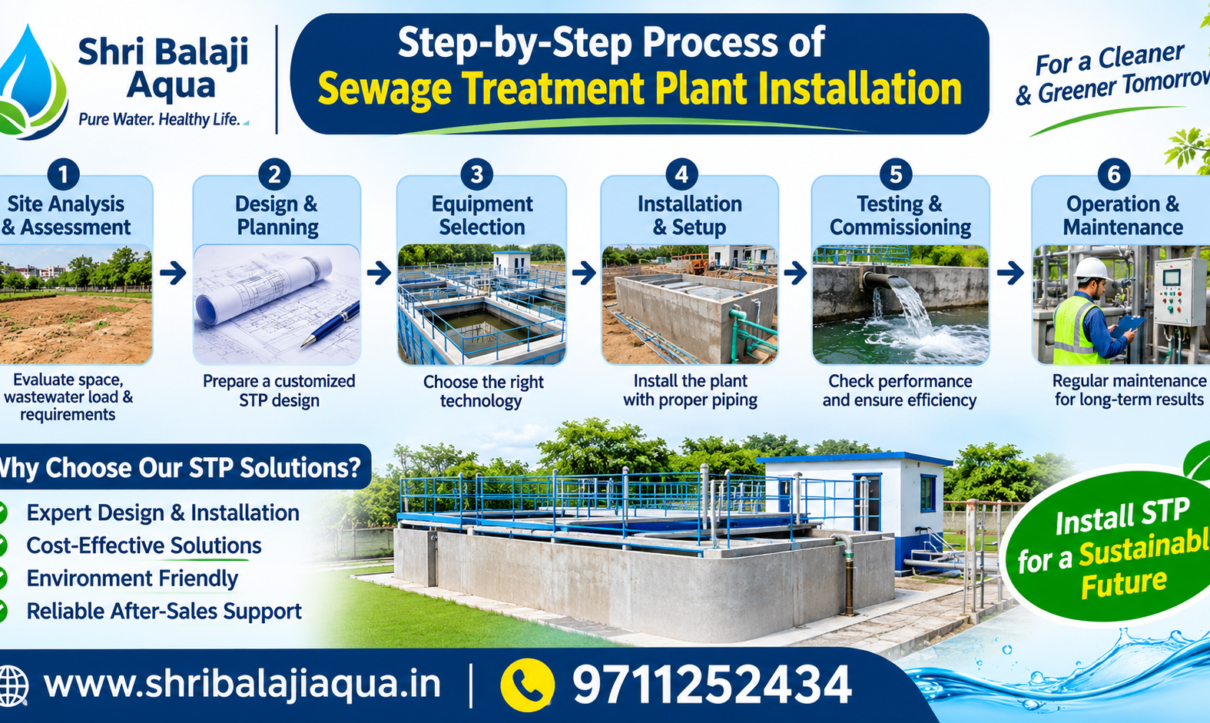
If you are looking for dependable sewage treatment plant installation in Noida or a quality osmosis water system in Noida, Shri Balaji Aqua is a name worth considering. The team offers end-to-end solutions, from site assessment and design to installation, commissioning, and ongoing maintenance, for residential, commercial, and industrial clients.
You can explore their services and request a consultation at https://shribalajiaqua.in/.
Maintenance Tips to Keep Your Systems Efficient
- Schedule regular servicing and inspections through an AMC.
- Clean screens and remove accumulated solids from the STP at the right intervals.
- Monitor blower and pump performance to catch issues early.
- Replace RO pre-filters and membranes on time.
- Test treated-water quality periodically to confirm it meets standards.
Preventive maintenance costs far less than emergency repairs and keeps your plant running at peak efficiency.
Final Thoughts
Responsible water management is no longer optional in a city like Noida. A properly designed STP keeps you compliant, saves water, and protects the environment, while an RO water system safeguards the health of everyone who depends on your supply. Together, they form a complete, sustainable water solution.
Ready to get started? Visit Shri Balaji Aqua to discuss your requirements and get a customized solution for your property.
Frequently Asked Questions (FAQs)
1. Is sewage treatment plant installation mandatory in Noida?
Large residential complexes, commercial buildings, hotels, hospitals, and industries are generally required to install and operate an STP under pollution control norms. Requirements vary by project size and type, so confirm applicability with the relevant authority or your service provider.
2. How much space is needed for an STP?
It depends on capacity and technology. MBBR and MBR systems are compact, and underground or packaged STPs can save surface space. A site survey will give an accurate estimate.
3. Can treated sewage water be reused?
Yes. Properly treated water can be used for gardening, toilet flushing, car washing, cooling towers, and construction, but not for drinking.
4. What is the difference between RO and UV water purifiers?
UV only kills bacteria and viruses and does not remove dissolved salts or heavy metals. RO removes dissolved solids and many chemical contaminants, so it suits high-TDS water. Many systems combine RO with UV for extra protection.
5. How often should an RO plant be serviced?
Pre-filters usually need replacing every few months, and membranes every 1 to 2 years, depending on water quality and usage. A regular AMC helps keep performance consistent.