 By
By Summary
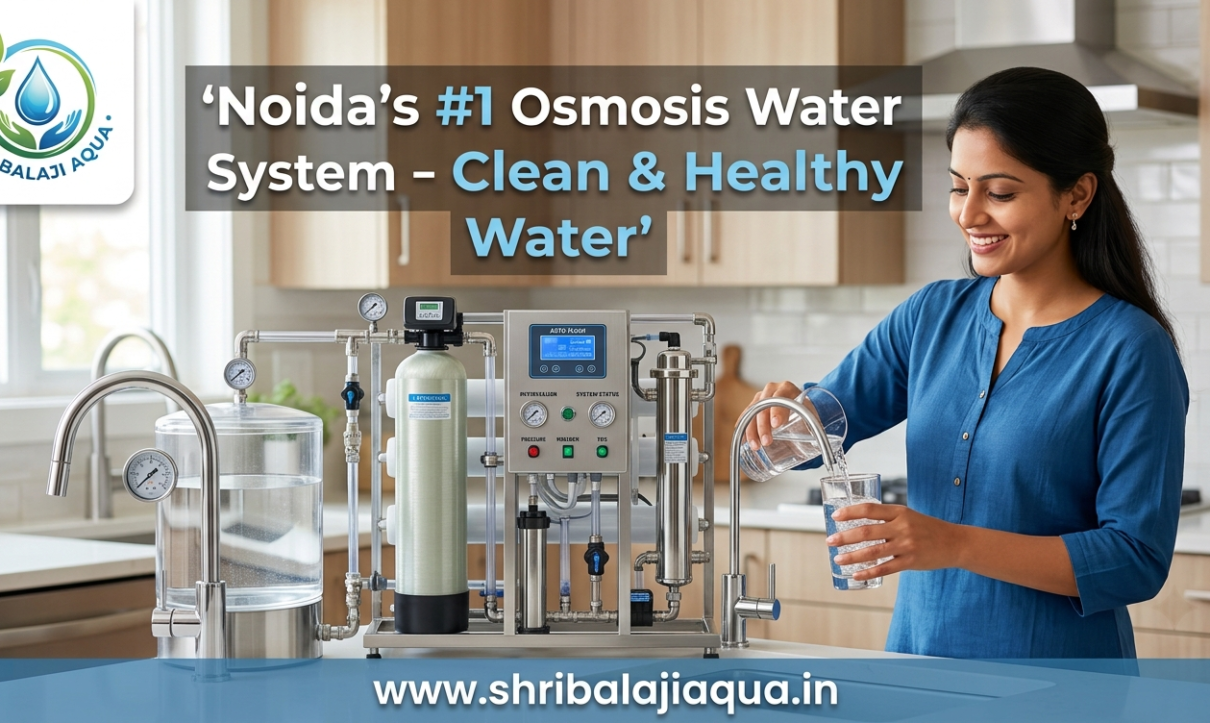
Noida’s rapid urbanisation and its unique mix of Ganga water and groundwater supply have pushed Total Dissolved Solids (TDS) levels in many sectors to alarming highs in some pockets touching 2,000 ppm, far above the Bureau of Indian Standards’ safe threshold of 500 ppm. In this environment, an osmosis water system is no longer a luxury; it is a health necessity. This article walks you through everything you need to know about osmosis water systems in Noida what they are, how they work, why Noida’s water makes them essential, what to look for when choosing one, and why Shri Balaji Aqua has earned the trust of thousands of Noida households and businesses.
Table of Contents
- The Water Crisis Hidden in Your Noida Tap
- What Is a Reverse Osmosis (RO) Water System?
- How an Osmosis Water System Works — Stage by Stage
- Why Noida Specifically Needs an Osmosis Water System
- Key Parameters to Check Before Buying an RO System in Noida
- Types of Osmosis Water Systems Available in Noida
- Shri Balaji Aqua – Noida’s Most Trusted Water Purification Partner
- RO System Maintenance: What Noida Residents Must Know
- Common Mistakes People Make When Buying an Osmosis System
- Frequently Asked Questions (FAQs)
- Conclusion
- About the Author
The Water Crisis Hidden in Your Noida Tap
Walk into any home in Sector 62, Sector 76, Sector 137, or Greater Noida West and ask residents about their drinking water. Most will tell you the same story — the water looks clear, but it tastes off, leaves white deposits on vessels, and has caused stomach problems more than once.
The reason is not difficult to find. Noida’s primary water supply comes from treated Ganga water sourced at the Pratap Vihar treatment plant. During peak demand, however, this supply blends with local groundwater drawn from tube wells and Ranney wells a mix that significantly dilutes overall water quality across distribution networks.
Studies on groundwater in Noida and Greater Noida have recorded TDS readings ranging from 500 ppm to as high as 2,000 ppm in some sectors, hardness levels touching 975 mg/L at certain sampling sites (well above the IS:10500-2012 permissible limit of 600 mg/L), and chloride content breaching acceptable limits in localized pockets. On top of this, falling groundwater tables mean that contaminants grow more concentrated as aquifer levels drop. Add construction runoff and aging pipeline infrastructure, and you have a recipe for water that no standard filter can adequately treat.
The only technology proven to handle water at these contamination levels, and the one now recommended across Noida’s high-TDS sectors, is reverse osmosis the core of every modern osmosis water system.
What Is a Reverse Osmosis (RO) Water System?
A reverse osmosis (RO) water system is an advanced, multi-stage purification technology that forces water through a semi-permeable membrane with pores as small as 0.0001 micrometres. This membrane is fine enough to block dissolved salts, heavy metals, bacteria, viruses, pesticides, and other contaminants while allowing pure water molecules to pass through.
Unlike simple sediment filters or UV-only systems, an osmosis water system can remove 95% -99% of dissolved salts, ions, particles, organics, bacteria, and pyrogens from feed water. Any contaminant with a molecular weight greater than 200 is effectively rejected by a correctly functioning RO membrane making it the gold standard in water purification science.
Modern osmosis water systems sold in Noida go well beyond the basic RO membrane. They combine multiple pre- and post-filtration stages including sediment filters, activated carbon blocks, UV chambers, UF (ultrafiltration) layers, mineralizers, and TDS controllers to deliver water that is not merely safe, but genuinely healthy.
How an Osmosis Water System Works – Stage by Stage
Understanding the filtration journey helps you appreciate exactly what your purifier does before water reaches your glass.
Stage 1 – Sediment Pre-Filter
Incoming water first passes through a sediment filter that traps visible particles: dirt, sand, rust flakes, and suspended solids. This protects all subsequent filtration stages from early clogging and physical damage.
Stage 2 – Activated Carbon Block Filter
Water moves through a carbon block that captures chlorine, volatile organic compounds (VOCs), chloramines, and chemicals responsible for bad taste and odour. This stage is particularly important in Noida, where municipal water is chlorinated during treatment. Chlorine left untreated would degrade the RO membrane rapidly.
Stage 3 – The RO Membrane (The Heart of the System)
This is where the real purification happens. Under pressure, water is forced through the semi-permeable membrane. Heavy metals like lead and arsenic, dissolved salts, nitrates, fluorides, bacteria, and viruses are blocked and flushed away as concentrate waste. Only pure water molecules cross to the other side.
Stage 4 – Post-Carbon / Polishing Filter
Purified water then passes through a polishing carbon filter that removes any residual taste or odour picked up from the storage tank, delivering fresh, clean-tasting water at the tap.
Stage 5 – Mineralizer / TDS Controller (Available in Advanced Models)
Since the RO process strips virtually all minerals, including beneficial ones, advanced systems re-introduce essential minerals like calcium and magnesium in controlled quantities. A TDS controller lets you calibrate the mineral balance so water tastes natural rather than flat.
Stage 6 – UV Chamber (In RO+UV Systems)
A UV lamp provides an additional kill stage for any residual biological contaminants that may have passed earlier filters particularly important for water supplied from tankers or during monsoon season when microbial loads spike.
Osmosis Water System: Filtration Stages & What They Remove
| Stage | Filter Type | Primary Contaminants Removed |
| 1 | Sediment Filter | Dirt, sand, rust, suspended particles |
| 2 | Activated Carbon Block | Chlorine, VOCs, bad taste, odour |
| 3 | RO Membrane (0.0001 µm) | Heavy metals, dissolved salts, bacteria, viruses, nitrates, fluoride |
| 4 | Post-Carbon Polishing | Residual taste, odour from tank |
| 5 | Mineralizer / TDS Controller | Adds back Ca, Mg; balances pH |
| 6 | UV Chamber (optional) | Bacteria, viruses (secondary kill stage) |
Why Noida Specifically Needs an Osmosis Water System
Every city has water quality challenges, but Noida’s combination of issues is particularly demanding and the data backs it up.
High TDS Levels Across Sectors TDS readings commonly fall between 500 and 1,200 ppm across Noida’s residential areas, with spikes toward 2,000 ppm reported in pockets of Greater Noida. The Bureau of Indian Standards defines 500 ppm as the acceptable upper limit for drinking water. At levels above this threshold, reverse osmosis is effectively mandatory; no other household-grade technology can adequately reduce dissolved solids to safe drinking levels.
Extreme Hardness Research on Noida-Ghaziabad groundwater samples found hardness values at multiple locations exceeding 600 mg/L the permissible BIS limit with the worst site (Sector 41, Noida) recording 975 mg/L. Hard water is not just unpleasant to drink; it corrodes household appliances, clogs pipelines, leaves scaling on vessels and taps, and over time contributes to kidney stone formation.
Bacterial and Chemical Contamination Poor sewage management and construction waste can seep into water sources, introducing harmful bacteria and pollutants. This is not a theoretical risk in Noida residents across sectors have reported waterborne illness directly linked to tap water quality.
Groundwater Over-Exploitation The Central Ground Water Board has flagged Noida’s groundwater levels as overexploited, depleting by roughly a metre per year. As water tables fall, contaminants become more concentrated, making already-high TDS and hardness values progressively worse without an effective home purification solution.
Monsoon Turbidity Spikes During the monsoon, surface runoff increases turbidity and microbial contamination in local water sources dramatically. A multi-stage osmosis water system handles these seasonal spikes far more effectively than any single-stage filter.
Noida Water Quality: Key Parameters vs. BIS Safe Limits
| Water Quality Parameter | BIS IS:10500 Safe Limit | Reported Range in Noida/Greater Noida | Risk Level Without RO |
| TDS (Total Dissolved Solids) | ≤ 500 mg/L | 500 – 2,000+ mg/L | Very High |
| Total Hardness | ≤ 600 mg/L | 170 – 975 mg/L | High |
| Chloride Content | ≤ 250 mg/L | Variable, locally elevated | Moderate–High |
| pH | 6.5 – 8.5 | 7.35 – 9.05 | Moderate |
| Turbidity | ≤ 1 NTU | Up to 103 NTU (in certain sites) | High (Monsoon) |
| Bacterial Contamination | Zero permissible | Possible via mixing / old pipes | High |
Key Parameters to Check Before Buying an Osmosis System in Noida
Shopping for an Osmosis Water System in Noida requires a bit more homework than in cities with gentler water profiles. Here is what to evaluate:
a) Your Water’s TDS Level Before purchasing, use a TDS meter (available inexpensively at any hardware store or online) to measure your tap water. If TDS exceeds 300 ppm, a standard RO system is the minimum requirement. Above 500 ppm, opt for a system with a higher-capacity membrane and a robust booster pump.
b) Source Water Type Know whether your housing society receives Ganga canal water, groundwater, or a blend. Mixed sources mean unpredictable TDS swings; a system with an in-built TDS controller is more suitable.
c) Storage Capacity For a family of four, a system with 7–10 litres of purified water storage is adequate. For larger families or offices, 12-15 litres or a commercial-grade unit is preferable.
d) Purification Technology Stack At minimum, look for RO + UV + UF. In Noida’s high-TDS conditions, a mineralizer or TDS controller is a valuable addition to retain essential minerals and improve taste.
e) Membrane Quality and Brand Certification Look for NSF/ANSI 58-certified membranes or ISI-marked units (BIS certification). These certifications confirm the product meets internationally and nationally defined contaminant reduction standards.
f) After-Sales Service Coverage Given Noida’s TDS conditions, RO membranes here foul at roughly three times the rate seen in cities with moderate-TDS water. A provider with a strong local service network, rapid response times, and a transparent Annual Maintenance Contract (AMC) is not optional, it is essential.
Types of Osmosis Water Systems Available in Noida
The osmosis water purification market in 2026 offers considerably more variety than even three years ago. Here is a quick reference to help you navigate the options:
Wall-Mounted Under-Counter RO Systems
Designed for kitchen under-sink installation, these units keep your countertop clear while delivering purified water through a dedicated faucet. Ideal for modern Noida apartments with modular kitchens.
Counter-Top RO Systems
A plug-and-play option that requires no drilling or professional installation. Suited for renters or those who move frequently, a common situation in Noida’s high-mobility professional housing markets.
Commercial RO Systems
Designed for offices, restaurants, small factories, and co-living properties. Available in capacities ranging from 25 litres per hour to several thousand litres per hour, commercial units handle the constant demand and high-TDS inputs that household units cannot sustain.
Industrial / High-Capacity RO Plants
For factories, large residential societies, schools, and hospitals industrial RO plants deliver large-scale water purification with automated monitoring, high-pressure pumps, and multi-membrane arrays.
Osmosis Water System Types: Quick Comparison for Noida Users
| System Type | Ideal User | Capacity Range | Key Feature | Best For |
| Wall-Mounted / Under-Counter | Nuclear / joint family | 7 – 15 L storage | Space-saving, concealed | Apartments in Sectors 18, 62, 75, 137 |
| Counter-Top RO | Renters, small families | 5–10 L storage | No installation required | Temporary residents, PGs |
| Commercial RO System | Offices, restaurants, clinics | 25 – 500 LPH output | High-volume, continuous flow | Office complexes, eateries |
| Industrial RO Plant | Large societies, factories | 500 LPH – several KLD | Automated, multi-membrane | Housing societies, industrial units |
Shri Balaji Aqua – Noida’s Most Trusted Water Purification Partner
When it comes to finding the right osmosis water system in Noida, brand matters — but local expertise, service speed, and technical depth matter more. That is the exact combination that has made Shri Balaji Aqua the name Noida residents and businesses turn to first.
Who Is Shri Balaji Aqua?
Shri Balaji Aqua is a dedicated water purification company operating across Noida and the greater NCR region. With years of hands-on experience navigating Noida’s specific water quality challenges from the high-TDS groundwater of Greater Noida West to the blended supply issues in central Noida sectors, the team brings knowledge that generic national brands simply cannot match at a local level.
What Sets Shri Balaji Aqua Apart
Deep Local Water Knowledge Shri Balaji Aqua’s technicians understand the TDS profiles, hardness variations, and seasonal contamination patterns across different Noida sectors. This means the system they recommend for your home is calibrated to your actual water, not a generic spec.
Full Range of Osmosis Water Systems From compact household RO+UV+UF units designed for apartments to high-capacity commercial RO systems for offices and restaurants, and full-scale industrial RO plants for residential societies and factories Shri Balaji Aqua covers every purification need under one roof.
Every osmosis water system installed by Shri Balaji Aqua is set up by trained, certified technicians who test post-installation TDS output, verify membrane integrity, and hand over a working unit not just a product box.
Given Noida’s demanding TDS conditions, where membranes foul faster and filter life shortens considerably compared to moderate-TDS cities, Shri Balaji Aqua maintains a local team available for fast-response service calls across Noida sectors.
Transparent AMC Plans Shri Balaji Aqua offers clear, jargon-free Annual Maintenance Contracts that cover preventive servicing, filter replacement, and component checks keeping your osmosis water system performing at its best year-round without surprise costs.
Customer-First Approach Before recommending any system, Shri Balaji Aqua conducts a water quality check to understand your specific TDS levels, water source, and usage pattern. The recommendation you receive is based on your water, not sales targets.
Services Offered by Shri Balaji Aqua
- Supply and installation of household RO water purifiers (RO / RO+UV / RO+UV+UF)
- Commercial RO system supply, installation, and commissioning
- Industrial RO plant design and installation
- RO system repair and servicing
- Filter and membrane replacement
- AMC (Annual Maintenance Contract) for all brands
- TDS testing and water quality consultation
- RO spare parts supply
What Customers Say – Google Reviews
Nothing speaks louder than the words of real customers. Here is what Noida residents and businesses are saying about Shri Balaji Aqua on Google:
Tarun Arora The owner is a very humble, polite and knowledgeable person. I went to inquire about a small STP plant. He properly explained everything and quoted me the best rates.
Vinay Pal Ion Exchange Ltd. authorised dealers of all types of original commercial RO spare parts are easily available here at very reasonable prices.
Ravi Kumar Excellent product and good service.
Dushyant Saraswat New startup and good behaviour.
Three things stand out across these reviews: the knowledge and approachability of the leadership, the availability of genuine spare parts at fair pricing, and the quality of both product and service. These are exactly the qualities that matter most when choosing a long-term water purification partner in a city like Noida.
RO System Maintenance: What Noida Residents Must Know
An osmosis water system in Noida requires more frequent maintenance than the same system would in a city with lower TDS. Understanding this upfront helps you plan costs and avoid sudden failures.
Why Noida’s Water Ages Membranes Faster At TDS levels of 900+ ppm, RO membranes can foul three times faster than in moderate-TDS cities. A membrane that would last 12 – 18 months in a city with 300 ppm TDS water may need replacement in 4 – 6 months in high-TDS pockets of Noida and Greater Noida. This is not a product defect, it is a function of water chemistry.
Signs Your RO System Needs Servicing
- Reduced water flow from the purified water tap
- TDS of output water rising above 30–40 mg/L (check with a TDS meter)
- Unusual taste or odour in purified water
- Strange noise from the booster pump
- Indicator light showing filter replacement alert
Recommended Maintenance Schedule for Noida
- Pre-filters (sediment + carbon): Every 3 – 4 months (standard: every 6 months)
- RO membrane: Every 6 – 12 months depending on incoming TDS
- Post-carbon polishing filter: Every 6 – 12 months
- UV lamp: Annually
- Storage tank cleaning: Every 6 months
Maintenance Schedule for Osmosis Water Systems in Noida vs. Standard Recommendations
| Component | Standard Replacement Interval | Recommended Interval for High-TDS Noida Areas | Why More Frequent |
| Sediment Pre-Filter | Every 6 months | Every 3–4 months | High particulate load in Noida groundwater |
| Activated Carbon Filter | Every 6 -12 months | Every 4 – 6 months | Heavy chlorination in municipal supply |
| RO Membrane | Every 12 – 18 months | Every 6 -12 months | TDS 500–2,000 ppm causes 3x faster fouling |
| Post-Carbon Polishing Filter | Every 12 months | Every 8 – 12 months | Residual taste management |
| UV Lamp | Every 12 months | Every 12 months | Same – UV output is independent of TDS |
| Storage Tank Cleaning | Every 12 months | Every 6 months | Bacterial growth risk in warm climate |
Common Mistakes People Make When Buying an Osmosis System
Buying Based on Brand Name Alone – Big national brands offer good quality, but their service network response times in specific Noida sectors can be slow. A locally rooted specialist like Shri Balaji Aqua often delivers faster support where it matters most.
Ignoring TDS Before Purchase – Many residents buy a purifier without measuring their actual water TDS. A system rated for 500 ppm input will underperform and age far faster when faced with 1,200 ppm Noida water. Always test first, then buy accordingly.
Skipping Mineralizer/TDS Controller – After RO filtration removes almost all dissolved content, water can taste flat and may lack the trace minerals your body is used to. Skipping the mineralizer stage is a common regret especially for children and elderly family members who may find demineralised water unpalatable.
Choosing Lowest Cost Over Total Cost of Ownership – A cheap purifier with expensive proprietary filters, slow service, or short membrane life can cost far more over three years than a slightly pricier unit from a specialist provider with a sensible AMC structure. Factor in servicing, not just the sticker price.
Not Servicing Regularly The biggest mistake of all is treating an RO system as a set-and-forget appliance. In Noida’s water conditions, irregular servicing means membranes clog, output TDS climbs silently, and the family continues drinking water they believe is purified but isn’t. Schedule regular maintenance ideally through a specialist with local knowledge like Shri Balaji Aqua.
(FAQs)
Q1. What TDS level is safe to drink from an RO water system in Noida?
Purified water output from an RO system should ideally be between 30 and 150 mg/L TDS. This range is considered safe and retains a pleasant taste, especially when a TDS controller or mineralizer is used. Output above 200 mg/L from a system treating Noida’s high-TDS input suggests the membrane needs attention.
Q2. How often should I get my osmosis water system serviced in Noida?
In standard-TDS cities, annual servicing is often sufficient. In Noida particularly in sectors fed by groundwater with TDS above 600 ppm, servicing every 4 – 6 months for pre-filters and every 6 -12 months for the RO membrane is more appropriate. Shri Balaji Aqua can set up a service schedule tailored to your sector’s water profile.
Q3. Is RO water safe for babies and elderly people?
Yes – provided the system includes a mineralizer or TDS controller that adds back essential minerals like calcium and magnesium. Completely demineralised water (with no TDS controller) is not recommended for long-term exclusive consumption. Modern systems from Shri Balaji Aqua include this feature as standard in household configurations.
Q4. Can Shri Balaji Aqua service an RO system from another brand?
Yes. Shri Balaji Aqua provides AMC and repair services for all major brands, not just their own installations. If you already have a purifier installed and need reliable local servicing, Shri Balaji Aqua can take over its maintenance.
Q5. What is the difference between RO and UV purification?
RO (reverse osmosis) removes dissolved salts, heavy metals, chemicals, and biological contaminants through membrane filtration. UV purification uses ultraviolet light to inactivate bacteria and viruses but does not reduce dissolved solids or TDS. For Noida’s high-TDS water, RO is the necessary foundation and UV adds an additional layer of biological protection on top.
Q6. Does an osmosis water system waste a lot of water?
Standard RO systems discharge a certain amount of concentrated reject water. Modern high-recovery systems significantly reduce this waste, and reject water can often be repurposed for mopping, gardening, or car washing — a practice Shri Balaji Aqua advises all customers to adopt as part of responsible water use.
Q7. Do I need a commercial RO system for my office in Noida?
If your office has more than 15–20 people or requires continuous water dispensing, a commercial RO system (25 LPH output or more) is recommended over household units. Shri Balaji Aqua designs and installs commercial RO systems across Noida’s office corridors, including Sector 62, Sector 63, and the Expressway belt.
Conclusion
Noida’s water quality situation is not going to resolve itself quickly. With TDS readings in many sectors running well above safe limits, groundwater tables falling, and the city’s continued expansion adding pressure to an already-stretched distribution network, the need for a reliable osmosis water system in Noida is only growing.
Reverse osmosis technology remains the most rigorously proven, scientifically validated method for reducing dissolved solids, heavy metals, bacteria, viruses, and chemical contaminants to safe levels. But technology alone is not enough installation quality, local expertise, and consistent servicing are what actually protect your family’s health over time.
That is precisely what Shri Balaji Aqua delivers. With deep knowledge of Noida’s sector-specific water profiles, a complete range of household, commercial, and industrial RO solutions, expert installation, and a responsive local service team, Shri Balaji Aqua has established itself as Noida’s most trusted osmosis water system partner.
If you are evaluating an osmosis water system in Noida whether for a new apartment, an existing home, an office, or a large residential society the first step is a water quality check. Reach out to Shri Balaji Aqua and let their specialists assess your water, recommend the right system, and set you up with a maintenance plan that keeps your water genuinely pure, not just apparently clear.
About the Author
Mr. Rajat Sikka Managing Director, Shri Balaji Aqua Pvt. Ltd.
Mr. Rajat Sikka is the Managing Director of Shri Balaji Aqua Pvt. Ltd., one of Noida’s most respected water purification specialists. With hands-on expertise spanning household RO systems, commercial water treatment plants, industrial RO installations, and sewage treatment solutions, Mr. Sikka brings a rare combination of technical depth and practical field experience to every customer consultation.
Known in the industry for his straightforward, no-pressure approach reflected consistently in customer feedback Mr. Sikka’s philosophy is simple: understand the water first, then recommend the right solution. Under his leadership, Shri Balaji Aqua has grown into a trusted name across Noida’s residential, commercial, and industrial sectors, serving clients who value expert advice, genuine parts, and dependable after-sales support over flashy promises.
Mr. Sikka is also an authorised dealer for Ion Exchange Ltd., one of India’s foremost water treatment companies, ensuring that Shri Balaji Aqua customers have access to original, certified components at competitive prices.
This article was written based on publicly available water quality research, BIS standards, and current purification technology data. All water quality figures cited reflect reported findings from scientific studies and local reporting as of June 2026.