 By
By And What Every Industrial Buyer Must Know Before Installing One
Summary
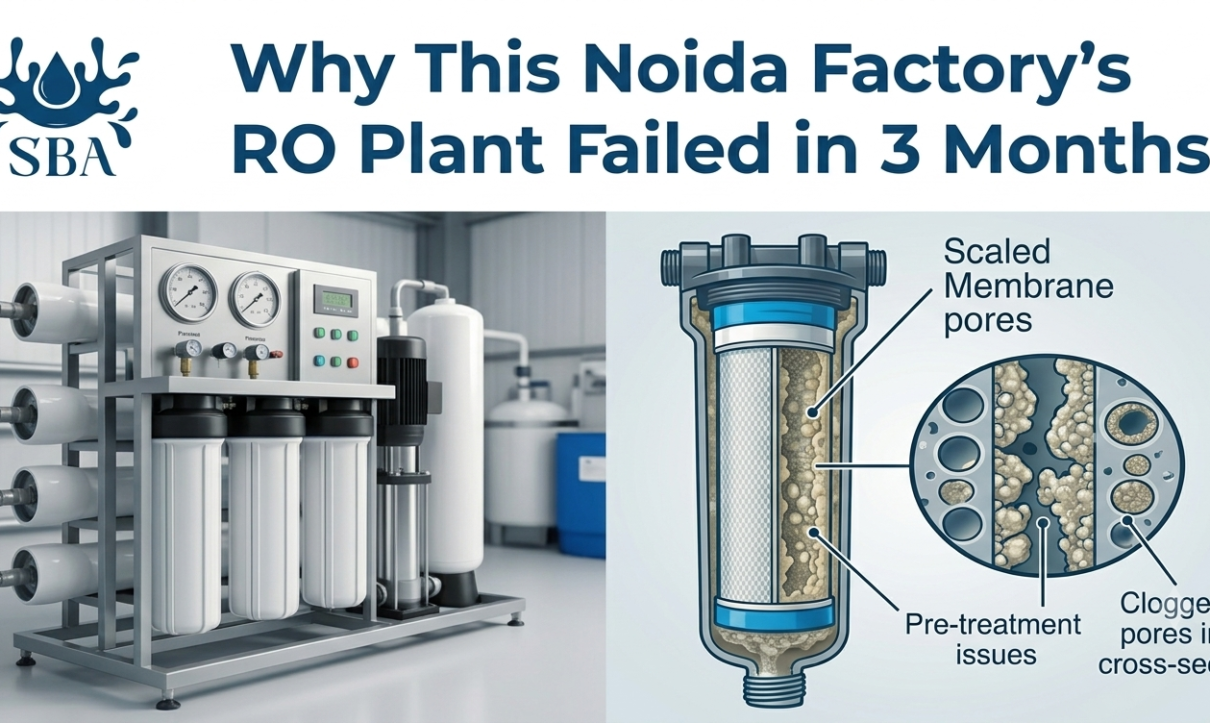
A manufacturing unit in Sector 63, Noida, invested in a 2000 LPH RO plant expecting years of reliable, purified water for their production process. Within ninety days, output had dropped to less than half its rated capacity. TDS levels in the product water had climbed well above acceptable limits. The high-pressure pump was running hot. And the membranes which should have lasted three to five years under normal operating conditions were already showing irreversible fouling that no cleaning cycle could recover. The plant was effectively dead in a season. This article examines exactly what went wrong, why it happens more often than the industry admits, and how working with Shri Balaji Aqua as your trusted supplier of a 2000 LPH RO plant in Noida is the difference between a water treatment investment that works and one that fails before it pays for itself.
The Morning the Output Numbers Stopped Making Sense
The plant supervisor noticed it first on a Tuesday morning in the third month of operation.
The 2000 LPH RO plant – installed with some confidence and a degree of negotiated urgency, because the factory’s production line needed a reliable water source – was showing a permeate flow rate of roughly 900 litres per hour. Against a rated output of 2000 LPH, that was a 55% drop in productive capacity. The reject ratio had climbed. The operating pressure had increased noticeably. And a quick TDS check on the product water produced a reading that made the supervisor reach for his phone immediately.
The TDS of the permeate – the purified output water – had risen above 400 ppm. The factory’s process requirement demanded water below 100 ppm. What was coming out of the RO plant was not meeting the standard the plant had been specified and purchased to deliver.
Three months in. A significant capital investment. And a water treatment system that was producing neither the volume nor the quality the factory needed.
The diagnostic process that followed produced a picture that is, unfortunately, familiar to RO plant engineers across industrial Noida – a picture built not from one catastrophic failure but from several compounding ones that were entirely predictable and entirely preventable.
What the Diagnostic Found – Five Compounding Failures in One System
Failure 1: The Feed Water Was Never Properly Tested Before Installation
This is where the failure began not at the membrane, not at the pump, but at the very first step of the process that should happen before any RO plant is sized, specified, or installed.
The factory’s raw water source was a combination of municipal supply and borewell water, blended depending on availability. The borewell water in this part of Noida carries significantly elevated levels of hardness calcium and magnesium along with iron content and, at certain times of year, elevated silica levels. These are not unusual characteristics for groundwater in this region of Uttar Pradesh. They are, however, characteristics that must be known before a 2000 LPH RO plant is designed, because they determine the pre-treatment specification the system needs to function safely.
No comprehensive feed water analysis was conducted before installation. The vendor who supplied the plant assumed a standard TDS figure for the area and sized the pre-treatment system accordingly. What actually arrived at the membranes was harder, more iron-laden, and more silica-rich than the system had been designed to handle.
A 2000 LPH RO plant treating raw water with 2000 ppm TDS at a flow rate of 5000 LPH is designed to produce 2000 LPH of purified water with less than 100 ppm TDS. But that specification is only achievable when the pre-treatment system is matched to the actual feed water chemistry, not a generalised assumption about it.
The result of this mismatch was predictable. Scaling began forming on the membrane surfaces from the first weeks of operation, at a rate the antiscalant dosing system sized for a lighter hardness load could not adequately counter.
Failure 2: The Antiscalant Dosing System Was Undersized and Incorrectly Calibrated
An antiscalant dosing system is used to prevent the formation of scales on the RO membrane. It works by introducing a chemical solution into the feed water upstream of the membranes, disrupting the crystallisation process that causes calcium, magnesium, and silica compounds to deposit on membrane surfaces.
The dosing system installed on this plant was a basic electronic diaphragm pump with a capacity of 0 to 5 LPH standard specification for many 2000 LPH installations. The problem was not the equipment type but the calibration. The dosing rate had been set during commissioning based on assumed water hardness figures. No adjustment was made after actual feed water testing because actual feed water testing was never done.
The probable reasons for membrane fouling include high calcium or silica in the feed water or inconsistent antiscalant dosing. When the dosing rate is inadequate for the actual scaling potential of the feed water, the antiscalant provides partial protection which means scaling proceeds, just more slowly. Over ninety days of continuous operation, partial protection against a high scaling load produces the same end result as no protection. It just takes slightly longer to arrive.
By month three, the membrane surfaces carried a scale deposit that had reduced permeability across the entire membrane bank. Flux had dropped. Differential pressure had risen. And the system was responding by running higher operating pressures which accelerated the problem rather than solving it.
Failure 3: Inadequate Pre-Filtration Before the Membranes
A properly specified 2000 LPH RO plant passes feed water through a multi-stage pre-treatment sequence before it ever reaches the membranes. The sequence includes a multi-grade sand filter to remove suspended particles, sand, silt, and turbidity protecting downstream equipment. This is followed by an activated carbon filter to remove chlorine and organic contaminants. Then an antiscalant dosing system to manage hardness. Then a 5-micron cartridge filter as a final barrier before the high-pressure pump and membranes.
The plant installed at this factory used a sand filter that had been sized for a lower turbidity load than the blended feed water actually carried. During periods when the borewell contribution to the blend was higher, which happened unpredictably depending on municipal supply availability, turbidity spikes were passing through the sand filter and reaching the cartridge filter.
Cartridge filters in a 2000 LPH system require regular inspection and replacement typically every four to eight weeks depending on feed water quality. At this factory, the cartridge filter had not been inspected since commissioning. It was found, during the diagnostic, to be severely blinded, blocking flow rather than providing filtration, creating differential pressure problems upstream and contributing to flow restriction across the whole system.
A membrane’s surface becomes extremely soaked with materials like calcium, strontium, barium, and different salts, which reduces the amount of water that can penetrate through the membrane. When pre-filtration is inadequate, this process is dramatically accelerated.
Failure 4: Chlorine Was Reaching the Membranes
This was the most damaging finding of the diagnostic and the one that converted a recoverable membrane fouling problem into an irreversible membrane damage situation.
The municipal portion of the factory’s feed water supply carried residual chlorine – as all treated municipal water does. Chlorine is introduced at the municipal treatment stage as a disinfectant. For an RO system using thin film composite membranes which is the standard membrane type for industrial applications chlorine above 0.01 parts per million is damaging. Oxidisers like chlorine will harm the concentration layer of the membrane’s construction, particularly the thin film composite layer.
The activated carbon filter in the pre-treatment system is specifically designed to remove residual chlorine before feed water reaches the membranes. But the carbon filter medium requires periodic replacement typically every six to twelve months, with inspection to verify effectiveness. The carbon filter installed on this system had not been maintained. Its adsorption capacity was exhausted. Chlorine was passing through and reaching the membranes on every fill cycle that drew municipal water.
The damage this causes is not reversible. Unlike scale fouling – which can often be treated with acid cleaning oxidative damage to the thin film composite layer destroys the membrane’s selective permeability. Salt passage rises sharply and permanently. The only solution is membrane replacement.
The TDS spike the supervisor had measured was not a sign of fouling that could be cleaned. It was a sign of membranes that had been chemically destroyed.
Failure 5: No AMC, No Monitoring, No Early Warning
The final layer of this failure was the absence of any structured maintenance programme or monitoring protocol.
Ignoring maintenance protocols causes a cascade of problems reduced filtration efficiency as fouled membranes lose their permeability, decreasing water output and quality; increased energy consumption as blockages and inefficiencies force pumps to work harder; and equipment failure as worn-out parts such as pumps, motors, and gauges suffer premature breakdown.
None of the warning signs that preceded the full performance collapse were caught early because nobody was looking for them systematically. A simple log of daily permeate flow rate and TDS measurement would have flagged the declining trend within the first four weeks of operation. An antiscalant pump calibration check in week two would have revealed the inadequate dosing rate. A cartridge filter inspection in week six would have caught the blinding before it caused upstream pressure problems.
A structured annual maintenance contract with defined inspection intervals, parameter logging, and pre-emptive component servicing is not an optional add-on to an industrial RO plant. It is the mechanism by which the investment made at installation is protected through the system’s operating life.
Without it, what happened to this Noida factory happens predictably and repeatedly.
What a Properly Specified 2000 LPH RO Plant Actually Looks Like
Understanding what went wrong at this factory requires understanding what a correctly specified, properly installed 2000 LPH RO plant should contain and what each component is doing.
Standard Components of a 2000 LPH RO Plant – Function and Quality Indicators (2026)
| Component | Function | Quality Indicator | Failure Risk if Compromised |
| Raw Water Feed Pump | Supplies consistent feed pressure to pre-treatment system | Kirloskar / equivalent rated brand, matched to feed head | Inconsistent feed pressure fluctuating membrane performance |
| Multi-Grade Sand Filter (MGF) | Removes suspended solids, turbidity, silt to 30 micron | Non-corrosive vessel, rated to 6.5 kg/cm² | Turbidity breakthrough accelerated membrane fouling |
| Activated Carbon Filter (ACF) | Removes residual chlorine and organic compounds | Carbon medium with verified adsorption capacity, regular replacement schedule | Chlorine breakthrough irreversible membrane oxidation damage |
| Antiscalant Dosing System | Prevents scale formation on membranes | Electronic diaphragm pump, Italy / equivalent, calibrated to actual feed water hardness | Scale deposition flux decline, pressure rise, membrane replacement |
| 5-Micron Cartridge Filter | Final barrier before membranes removes fine particles | Regular inspection and replacement per feed water quality | Blinding flow restriction, upstream pressure problems |
| High-Pressure Pump | Pressurises feed water to RO operating pressure (9–14 kg/cm²) | Rated brand matched to system capacity, thermal protection | Overpressure or underpressure membrane mechanical stress |
| RO Membranes | Core separation element removes dissolved salts to achieve <100 ppm TDS | Thin film composite, verified brand (Dow, Hydranautics, or equivalent) | Fouling, scaling, oxidation reduced rejection, TDS spike |
| Membrane Pressure Vessels / Housings | Contain membranes under operating pressure | FRP or SS construction, rated to operating pressure | Leaks contamination of product water |
| Automatic Flush Valve | Flushes membranes at shutdown to prevent stagnant water fouling | Automatic operation, correctly timed | Biological fouling during standby periods |
| Flow Meters and Pressure Gauges | Monitor system performance permeate flow, reject flow, differential pressure | Calibrated, readable, correctly positioned | No early warning of performance decline |
| Control Panel | Automates operation level sensing, pump control, alarm functions | Fully automatic with low/high level protection | Manual dependency human error in operation |
Why Noida’s Industrial Feed Water Makes Pre-Treatment Design Critical
Noida’s industrial belt spanning sectors from 58 to 80 draws water from a combination of sources that create a challenging and variable feed water profile for RO systems. Understanding this profile is essential for any business specifying a 2000 LPH RO plant in Noida.
The groundwater accessed through borewells across this area typically carries hardness levels significantly above what is common in municipal supplies. The geology of the upper Gangetic plain means high calcium and magnesium concentration is normal rather than exceptional. Iron content varies by depth and location but is frequently elevated enough to require specific pre-treatment consideration.
Municipal supply from the Noida Authority’s distribution network is treated and carries residual chlorine. When the two sources are blended, as commonly happens in industrial settings where water security requires dual sourcing, the feed water chemistry becomes variable rather than consistent. A system designed for a fixed TDS and hardness assumption performs suboptimally when that assumption is regularly wrong.
Water used in various industrial processes often contains impurities like salts, minerals, heavy metals, microorganisms, and chemicals, which can negatively impact production, equipment, and product quality.
A 2000 LPH RO plant specified for Noida industrial use must be designed around an actual feed water analysis not a regional average and must include pre-treatment capable of handling the peak conditions the feed water reaches, not just the typical conditions.
The Industries in Noida That Cannot Afford RO Plant Failure
The consequences of a failed RO plant are not the same across all industrial applications. In some contexts, the result is operational inconvenience. In others, it is a production halt, a regulatory breach, or a product quality failure with commercial consequences that dwarf the cost of the RO plant itself.
Industrial Sectors in Noida Dependent on 2000 LPH RO Plant Output (2026)
| Industry Sector | How RO Water Is Used | Consequence of Plant Failure |
| Food & Beverage Manufacturing | Process water, ingredient mixing, equipment washing | Production halt, product quality failure, regulatory non-compliance |
| Pharmaceutical / API Manufacturing | Process water, formulation, equipment sterilisation | Regulatory shutdown, batch rejection, GMP violation |
| Electronics & PCB Manufacturing | Rinsing, process cooling, deionised water production | Component quality failure, circuit contamination, production loss |
| Textile Processing | Dyeing, washing, finishing – – TDS-sensitive processes | Colour inconsistency, fabric defects, process chemical waste |
| Hospital / Healthcare Facilities | Drinking water, sterilisation, dialysis support | Patient safety risk, infection control failure |
| Hospitality / Institutional Catering | Drinking water, cooking, beverage preparation | Health compliance failure, guest health risk |
| Commercial & Residential Complexes | Drinking water supply, common area usage | Occupant health risk, regulatory non-compliance |
In pharmaceutical and food manufacturing, both of which have significant representation in Noida’s industrial sectors, water quality is a regulatory parameter, not just an operational preference. A 2000 LPH RO plant that drops below its rated TDS rejection is not simply inconvenient. It is a compliance failure that can result in batch rejection, production shutdown, and in some cases, regulatory action.
What Shri Balaji Aqua Does Differently for a 2000 LPH RO Plant in Noida
After the diagnostic was complete and the extent of the damage was understood, the factory engaged Shri Balaji Aqua – not to patch the failed system, but to replace it with one that was correctly specified from the ground up.
The contrast between the two installations tells the story of what separates a reliable 2000 LPH RO plant in Noida from an expensive liability.
Feed Water Analysis Before Any Specification Is Written
Shri Balaji Aqua begins every industrial RO plant engagement with a comprehensive feed water analysis. For a Noida industrial client, this means testing the actual source water – borewell, municipal, or blended – for TDS, hardness, iron, silica, pH, turbidity, chlorine, and biological load. The analysis results determine the pre-treatment specification. The pre-treatment specification determines the system design. The system design determines what is installed.
This sequence – test first, specify second, install third – is the sequence that prevents the kind of failure that destroyed the factory’s first installation. It is not an additional service charged separately. At Shri Balaji Aqua, it is the standard process, because specifying a system without it is not something they are willing to do.
Pre-Treatment Matched to Actual Feed Water Chemistry
The pre-treatment system supplied and installed by Shri Balaji Aqua for a 2000 LPH RO plant in Noida is specified to the results of the feed water analysis – not to a standard template. For high-hardness borewell water, this means a water softener or appropriately sized antiscalant dosing system calibrated to the actual calcium and magnesium load. For feed water with elevated iron, it means an iron removal stage. For blended municipal-borewell sources, it means activated carbon filtration specified to handle the chlorine load of the municipal contribution on maximum-municipal supply days.
The antiscalant dosing pump is calibrated against actual feed water chemistry before commissioning, and the calibration is documented and handed over to the client. When the factory’s maintenance team checks the dosing rate – as they are trained to do as part of the AMC programme – they have a reference figure to check against.
Verified Component Brands With Full Traceability
Every major component in a Shri Balaji Aqua 2000 LPH RO plant installation carries a verified brand specification. Membranes from Dow, Hydranautics, or equivalent global-standard manufacturers. High-pressure pumps from Kirloskar or equivalent rated brands. Pressure vessels to rated construction standards. Control panels with fully automatic operation and comprehensive alarm functions.
This is not brand snobbery – it is functional engineering. The difference between a high-pressure pump from a verified manufacturer and an unknown-origin equivalent is the difference between a component that performs to its rated specification under continuous industrial operating conditions and one that does not. After thousands of operating hours in a Noida industrial environment – heat, dust, variable power supply – the gap between genuine and imitation components becomes very visible.
Structured AMC That Protects the Investment
Shri Balaji Aqua provides annual maintenance contracts for every 2000 LPH RO plant they install. The AMC is not a reactive arrangement – it is a structured preventive maintenance programme with defined inspection intervals, documented parameter logs, and scheduled pre-emptive component replacement.
Cartridge filter inspection and replacement at intervals matched to feed water quality. Carbon filter effectiveness checks on a documented schedule. Antiscalant pump calibration verification. Permeate TDS and flow rate logging to establish a baseline and flag deviations before they become failures. Membrane cleaning protocols applied at specified differential pressure thresholds – before fouling becomes irreversible.
The factory that engaged Shri Balaji Aqua after their first plant failed now has a replacement 2000 LPH RO plant that has operated within specification for eighteen months. The permeate TDS has not risen above 85 ppm. The flow rate has not dropped below 1,920 LPH. Both figures are logged monthly and available for review.
The Maintenance Schedule That Every 2000 LPH RO Plant Owner Needs to Follow
Whether your plant was installed by Shri Balaji Aqua or any other vendor, the following maintenance schedule represents the minimum required to protect a 2000 LPH RO plant’s performance and service life under typical Noida industrial operating conditions.
Recommended Maintenance Schedule for a 2000 LPH RO Plant – Noida Industrial Conditions (2026)
| Maintenance Activity | Recommended Interval | What to Check / Action | Warning Signs if Skipped |
| Cartridge filter inspection | Every 4–6 weeks | Visual inspection, differential pressure check, replace if blinded | Flow restriction, upstream pressure rise |
| Antiscalant dosing rate verification | Monthly | Check dosing pump output against calibrated target rate | Scale formation on membranes – flux decline |
| Permeate TDS measurement | Daily / Weekly | Log reading, compare to baseline – flag if >10% above baseline | Rising TDS indicates membrane rejection decline |
| Permeate flow rate log | Daily / Weekly | Log reading, compare to baseline – flag if >10% below baseline | Declining flow indicates fouling or scaling |
| Carbon filter effectiveness check | Every 3 months | Free chlorine test on carbon filter outlet – should be zero | Chlorine breakthrough – irreversible membrane damage |
| Sand filter backwash | Weekly | Backwash to clear accumulated suspended solids | Turbidity breakthrough to downstream stages |
| High-pressure pump inspection | Every 6 months | Check for noise, heat, pressure consistency, seal condition | Pump failure – system shutdown |
| Chemical membrane cleaning (CIP) | When differential pressure rises >15% above baseline | Acid or alkaline cleaning per membrane manufacturer protocol | Scale and fouling become irreversible |
| Full system service | Annually | All above plus membrane performance test, control panel check | Cumulative deterioration – shortened system life |
The Five Questions Every Noida Factory Must Ask Before Installing a 2000 LPH RO Plant
Based on the diagnostic findings from the failed installation and the corrective work that followed, the following questions should be asked of every vendor before a 2000 LPH RO plant in Noida is specified and purchased.
1.Will you conduct a comprehensive feed water analysis before writing the specification?
If the answer is that a standard specification is suitable for the area, that is the same assumption that destroyed the first plant. Insist on actual analysis of your actual source water.
2.How is the antiscalant dosing rate determined and documented at commissioning?
A vendor who cannot explain their calibration methodology has not calibrated it meaningfully.
3.What brands of membrane and high-pressure pump are used, and can you provide datasheets for each?
The component specification is the engineering foundation of the plant. If it cannot be specified in writing before purchase, it cannot be relied upon.
4.What does your AMC programme include, and at what inspection intervals?
An AMC that is simply a response contract — we come when you call — is not preventive maintenance. The AMC should specify what is inspected, at what interval, and what is documented each time.
5.What is your response time if the plant goes down during production hours?
For a factory whose production process depends on a continuous water supply, the answer to this question is as important as any technical specification.
RO Plant Vendor Evaluation Criteria for Noida Industrial Buyers (2026)
| Evaluation Criterion | What to Expect From a Reliable Vendor | Red Flag Response |
| Feed water testing | Comprehensive analysis conducted before specification | “Standard spec suitable for Noida area” — no testing |
| Component specification | Named brands with datasheets provided in writing | Generic “quality components” — no brand specification |
| Antiscalant calibration | Calibrated to actual feed water, documented at handover | Set at commissioning, not revisited |
| AMC structure | Defined intervals, documented logs, pre-emptive replacement | Reactive-only — respond when called |
| Warranty terms | Written, covering specific failure modes, defined duration | Verbal only — or not offered |
| Emergency response | Committed response time during production hours | “We will come as soon as possible” — no commitment |
| Post-installation support | Training for in-house team on daily monitoring | Installation and handover only |
Conclusion
The Noida factory’s 2000 LPH RO plant did not fail because RO technology does not work. It failed because the system was specified without knowing the water it would treat, installed without the pre-treatment it needed, and operated without the maintenance programme that would have caught the warning signs before they became irreversible damage.
Every element of that failure was predictable. Every element of it was preventable. And every element of it is avoided when the right supplier is chosen from the beginning – one who tests before specifying, specifies before installing, and supports the investment through a structured maintenance programme after commissioning is complete.
Shri Balaji Aqua provides 2000 LPH RO plants in Noida built on this foundation. Feed water analysis is the starting point. Component specification is documented and verifiable. Commissioning includes calibration against actual water chemistry. And the AMC programme is structured, scheduled, and accountable – because the performance of the plant over its operating life is as much their responsibility as the quality of the installation.
The factory that chose Shri Balaji Aqua after their first plant failed did not make the same mistakes twice. They did not need to – because Shri Balaji Aqua’s process does not allow those mistakes to be made.For a comprehensive feed water analysis and specification for a 2000 LPH RO plant in Noida, contact Shri Balaji Aqua and speak directly with a water treatment engineer about your facility’s requirements.